
Twelve weeks ago this series started with a claim: that this is the best moment in decades to build a career in industrial automation. Time to cash that claim out with specifics — what the market wants, what to learn in which order, and how to position yourself whether you are graduating this summer or twenty years into the profession.
The shape of the shortage
The talent gap is not generic ‘engineers wanted’. It is ruthlessly specific. A capable mechanical or electrical generalist often cannot fill a controls-engineering seat that demands PLC fluency plus plant-floor instincts. Retirements are draining exactly that experience faster than universities replace it, and the specialisations in shortest supply — controls, OT cybersecurity, industrial data — sit precisely where this series has been walking.
You will see projections of millions of unfilled manufacturing roles by 2030 quoted from the large consultancies. We have not verified them and they are not load-bearing here. The practical version needs no forecast: if you can genuinely do this work, you will not struggle to find it.
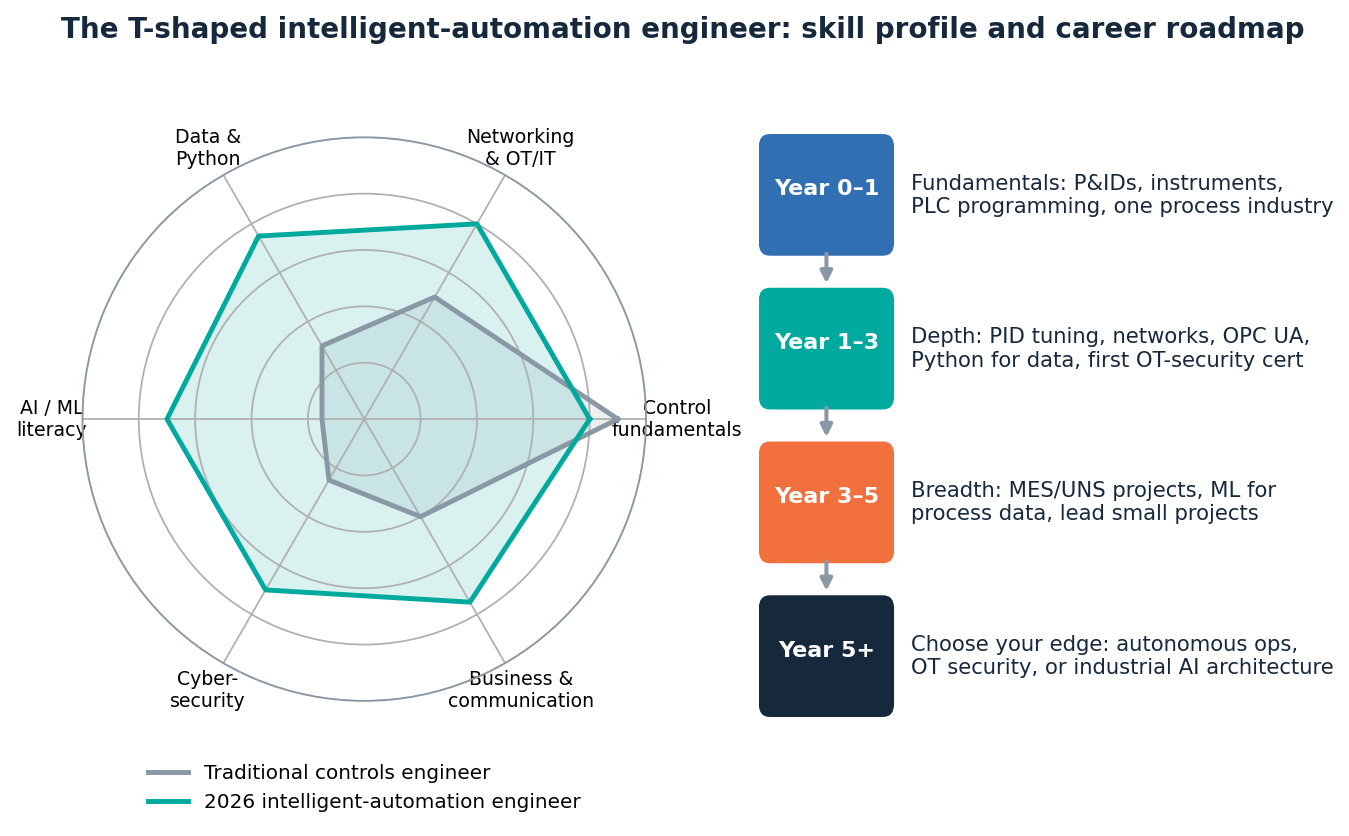
The T-shaped engineer, concretely
The vertical bar is what earns you the room’s respect and the interesting problems. Everything fashionable rests on it. Working level on the horizontal bar means exactly that — not software-engineer level, just enough to stop being blocked.
Practical moves, by career stage
Get any plant exposure you can: internships, site visits, even operator shadowing. Learn one PLC platform hands-on — simulators are free or cheap.
Build one public project. Take an open dataset, analyse a control loop or pump degradation in Python, write it up. That single artefact separates you from a stack of identical CVs.
Volunteer for the unglamorous data and integration work everyone else avoids. It is where the modern skills grow fastest, and nobody is competing with you for it.
Get one recognised credential in your chosen depth — ISA certifications for control, GICSP or the ISA/IEC 62443 certificates for security.
Write about what you learn. The industry’s knowledge lives in retiring heads. People who document publicly become known quantities quickly.
Your process intuition is the scarcest asset in the building. AI tooling makes it more valuable, not less, because somebody has to judge what the models propose.
Pair yourself deliberately with the data people. An experienced engineer plus a data scientist is the pairing where industrial AI work tends to survive contact with the plant.
Mentor loudly. The succession problem is real, and engineers who transfer knowledge visibly become hard to do without in a way no tool threatens.
The closing argument
Every technology in this series — the smart instrument, the virtual PLC, the namespace, the twin, the agent — shares one property. It amplifies the engineer who understands the plant.
None of it replaces that understanding. All of it is starved without it.
The industry has spent a decade building extraordinary leverage and is now short of people qualified to hold the lever. That is the opportunity. Take it.
Thank you for reading all twelve parts. If something here was useful, wrong, or missing, we would rather hear it than not — the links below both reach a human.
Key takeaways
- The shortage is specific: controls depth plus modern breadth. Generalists cannot fill the seats.
- Build the T — non-negotiable control fundamentals, plus Python and SQL, networks, ML literacy, security reflexes and communication.
- Students: one platform and one public data project. Years one to five: own the integration work, get one credential. Experienced: pair with data people, mentor visibly.
- Every technology in this series amplifies plant understanding. None replaces it.
- The invisible machines running your world
- Sensors, signals and the 75-year-old standard
- PLC, DCS, SCADA and the rise of virtual PLCs
- PID: the 80-year-old algorithm still running industry
- Industrial networks: fieldbus wars to Ethernet everywhere
- The automation pyramid is dying. Meet the unified namespace
- Digital twins: your plant’s second life
- AI on the plant floor: beyond the pilot purgatory
- Agentic AI: when the control room gets a co-pilot
- The self-optimising plant: how far can autonomy go?
- Hacking a factory: OT security in the age of convergence
- Your career in intelligent automation — you are here
Twelve parts done. What next?
Which part was most useful, and what should the next series cover? Tell us — it decides what gets written.
Twelve parts, from the 4–20 mA loop to the self-driving plant.
The series is finished and stays up. Start at part one, or use the roadmap to jump to whatever you need. Brought to you by SynapseAI.
Building the team, or building the plant?
We advise on industrial data architecture, industrial AI, OT security and digitalisation — vendor independent.