
Something changed in the last eighteen months. Industrial AI stopped being only about models that predict and started being about systems that do. Agentic AI — software that can sense conditions, reason through options, take actions and learn from outcomes — has moved from conference keynote to plant floor at startling speed.
Deloitte tracked agentic AI adoption in manufacturing quadrupling in a single year, from 6% to 24%. Their figure, not ours. Nothing in industrial technology moves that fast without a reason.
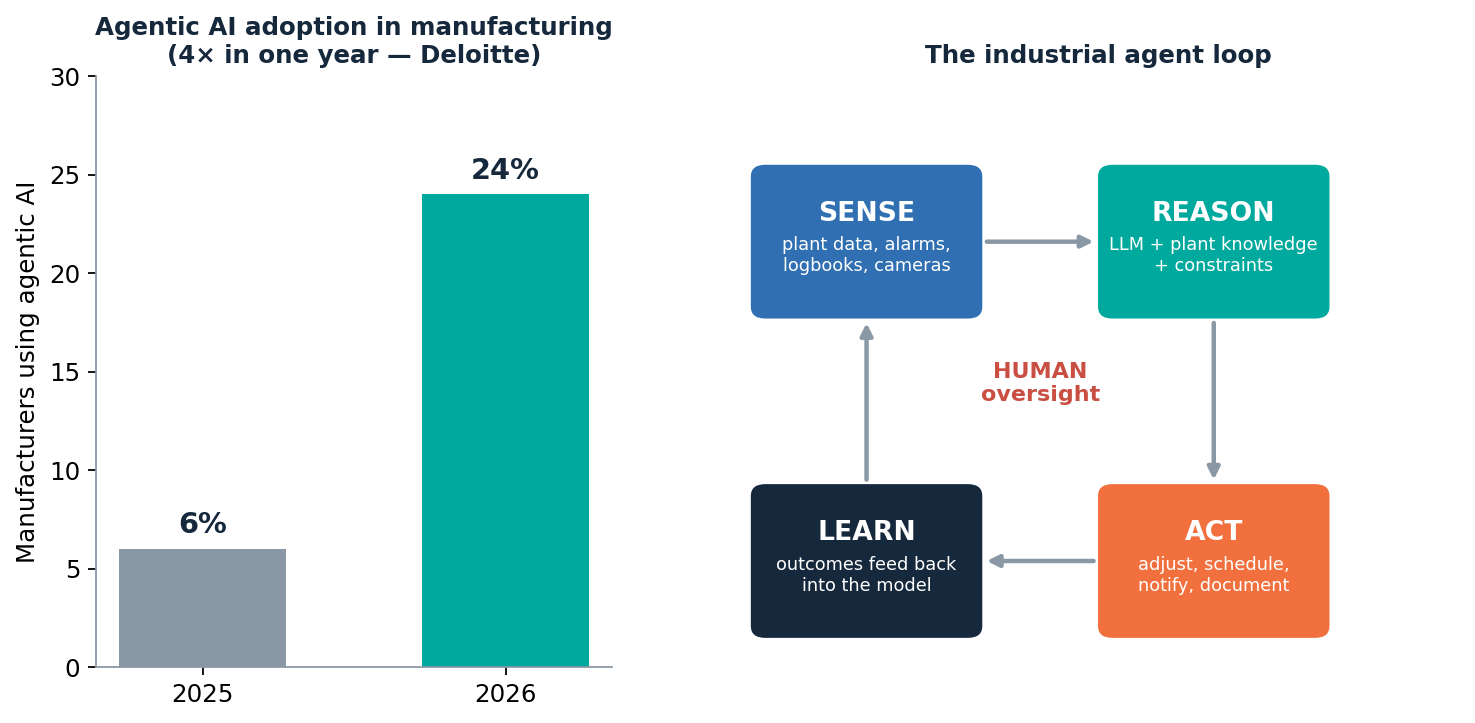
What an industrial agent actually does
Forget the humanoid-robot imagery. An industrial agent is software with plant context. The examples that exist are deliberately unglamorous: an agent that reads the overnight shift log, cross-references it against alarm history and the maintenance backlog, and hands the morning meeting a prioritised brief. An agent that notices a quality drift, queries the twin for probable causes, checks which are actionable, and drafts the work order.
Two reported deployments: Danfoss says 80% of its transactional order-processing decisions are now automated. Suzano says engineers asking questions in plain language instead of navigating SAP transactions cut materials-data query time by 95%. Both are companies reporting on themselves — useful as direction of travel, not as numbers for your business case.
The pattern in all of them is the same. The agent compresses the boring cognitive work — searching, cross-referencing, drafting, chasing — and hands a human something decision-ready. The human stays on the hook for the judgement.
Why the control room is fertile ground
A control room is drowning in exactly the kind of information a language model digests well: shift logs, alarm floods, procedures, permits, historian trends, maintenance records. Most of it is text or time series. Most of it is under-used. And the people who could connect the dots across all of it are busy running the plant.
An agent that watches all of it at once and never gets tired is not replacing the operator. It is the assistant every operator should have had twenty years ago.
The guardrails question, answered honestly
Should an agent write to the DCS? For most plants the answer today is: not directly, and anyone selling otherwise deserves hard questions. The pattern in deployments that hold up is graduated autonomy — earn each rung.
Observe and summarise
The agent reads everything and writes nothing. Briefings, summaries, draft reports. No action, no risk, and it is where almost everyone should start.
Where almost every deployment belongs todayRecommend, with approval
The agent proposes; a person approves. Work orders drafted but not raised, setpoint changes suggested but not sent. The approval step is the control, so it has to be real rather than a rubber stamp.
Act within hard limits
Only for well-bounded, low-consequence actions with a proven track record, and only inside limits enforced outside the agent. If the agent is the thing deciding what it is allowed to do, there is no limit.
Safety-instrumented functions stay untouchable, deterministic and utterly boring, exactly as they should be. Nothing in this article applies to them.
The plants getting value are the ones treating agent permissions like control-system management of change, not like an app install. That is an unexciting sentence, and it is the whole difference between a programme that compounds and one that gets switched off after an incident.
Key takeaways
- Agentic AI is software that senses, reasons, acts and learns. Reported adoption in manufacturing quadrupled in a year.
- Real deployments compress cognitive drudgework: shift briefings, root-cause drafts, order processing, data retrieval.
- Control rooms are ideal territory — rich in text and time-series data, chronically under-used.
- Graduated autonomy with limits enforced outside the agent is the mature pattern.
- Safety systems stay deterministic and untouched. That boundary is not a maturity rung to climb.
What’s your take?
Which rung is your site actually on — and who gets to decide when an agent moves up one? Join the conversation.
A 12-part journey from the sensor to the self-driving plant.
Each week, one article — building from the 4–20 mA loop all the way to plants that run themselves. Brought to you by SynapseAI.
Working out which rung your site belongs on?
We advise on industrial data architecture, industrial AI and digitalisation — vendor independent.