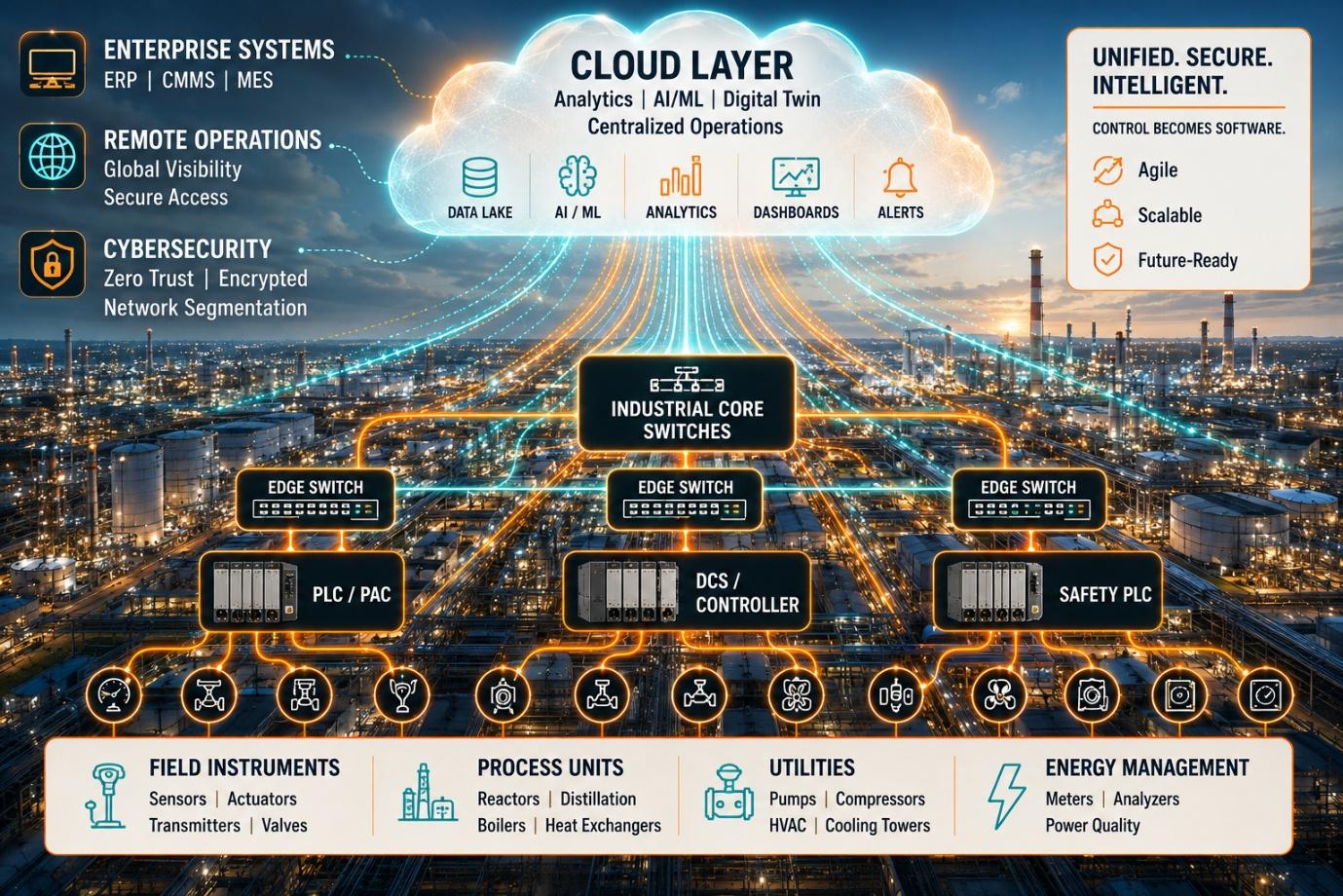
Nobody gets excited about plumbing until the house floods. Industrial networking is the plumbing of the intelligent plant, and it has a dramatic history: a decade of 'fieldbus wars' in which vendors fought viciously over incompatible standards, followed by an uneasy peace in which Ethernet won the physical layer but the protocol battles moved up a level. If you want to work on anything involving plant data — and every interesting project now involves plant data — you need this map.
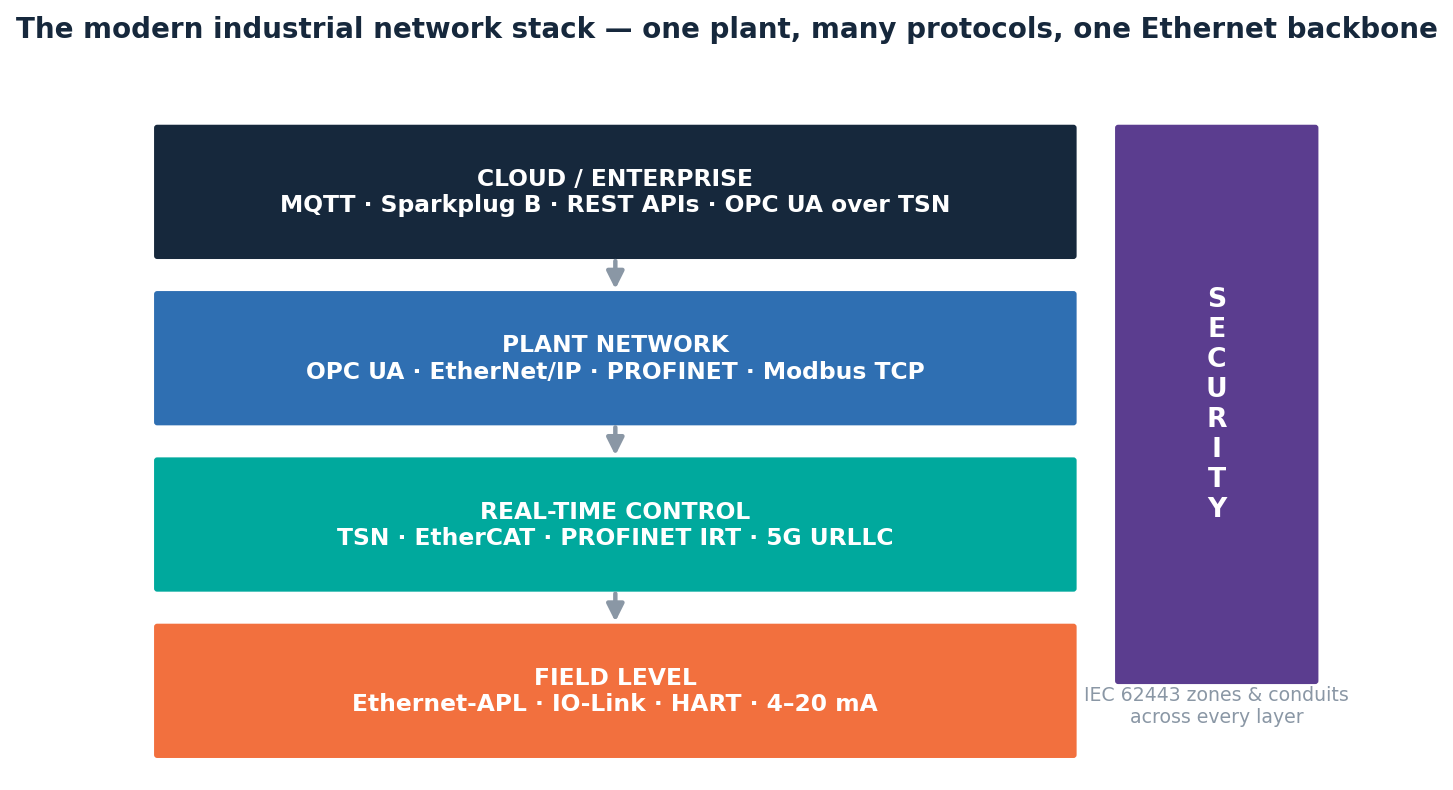
The stack, from dirt to cloud
At the field level, 4–20 mA and HART persist, joined by IO-Link for discrete sensors and now Ethernet-APL bringing two-wire Ethernet to process instruments. At the real-time control level, protocols like PROFINET IRT and EtherCAT deliver the microsecond determinism that motion control demands, with TSN (time-sensitive networking) gradually standardising that determinism into mainstream Ethernet — the IEC 60802 profile is the one to watch. At the plant network level, EtherNet/IP, PROFINET and Modbus TCP move controller data. And at the top, the IT-friendly protocols take over: OPC UA and MQTT.
OPC UA vs MQTT: the debate you'll actually encounter
OPC UA is the industrial data standard with everything built in: rich information models (a temperature isn't just a number — it carries units, ranges, and its place in the plant model), built-in security, and companion specifications for entire industries. Its weakness is weight; a full OPC UA implementation is a serious engineering commitment.
MQTT is the opposite philosophy: a featherweight publish-subscribe protocol from the IoT world. Devices publish data to a broker; anything interested subscribes. It's simple, scales beautifully, and with the Sparkplug B specification it gains the state management and payload structure that raw MQTT lacks. Its weakness is that simplicity — without discipline, an MQTT deployment becomes a junk drawer of inconsistent topics.
They're complements, not rivals. The argument about which one wins is usually an argument between people solving different problems.
The pragmatic answer emerging across industry: OPC UA where rich context and interoperability matter (machine-to-machine, vendor equipment integration), MQTT/Sparkplug as the backbone for moving data to brokers, historians and cloud. And that combination sets up the unified namespace, which is the next part of this series.
5G and the cable-free plant
Private 5G networks are past the pilot stage in mining, ports and large manufacturing sites. The killer applications aren't glamorous: connecting mobile assets (AGVs, cranes, vehicles), reaching places cable can't economically go, and enabling rapid reconfiguration of production lines. Ultra-reliable low-latency modes keep improving, but the honest current state is that 5G complements wired networks for mobility and flexibility rather than replacing the deterministic backbone. Treat anyone who says '5G will replace fieldbus' with the same scepticism as anyone who says 'AI will replace PID'.
Key takeaways
- Ethernet won the physical layer; the interesting choices now happen at the protocol level.
- OPC UA brings rich, secure, modelled data; MQTT/Sparkplug brings lightweight scalable movement. Use both for what they're best at.
- TSN (IEC 60802) is bringing deterministic real-time behaviour into standard Ethernet.
- Private 5G is real and growing — for mobility and hard-to-cable assets, not as a fieldbus replacement.
What’s your take?
OPC UA, MQTT, or both — what is actually carrying data out of your plant today, and what would you change if you were starting again? Join the conversation.
A 12-part journey from the sensor to the self-driving plant.
Each week, one article — building from the 4–20 mA loop all the way to plants that run themselves. Brought to you by SynapseAI.
Plant data stuck in systems that don’t talk?
We advise on industrial data architecture, OT security and digitalisation — vendor independent.