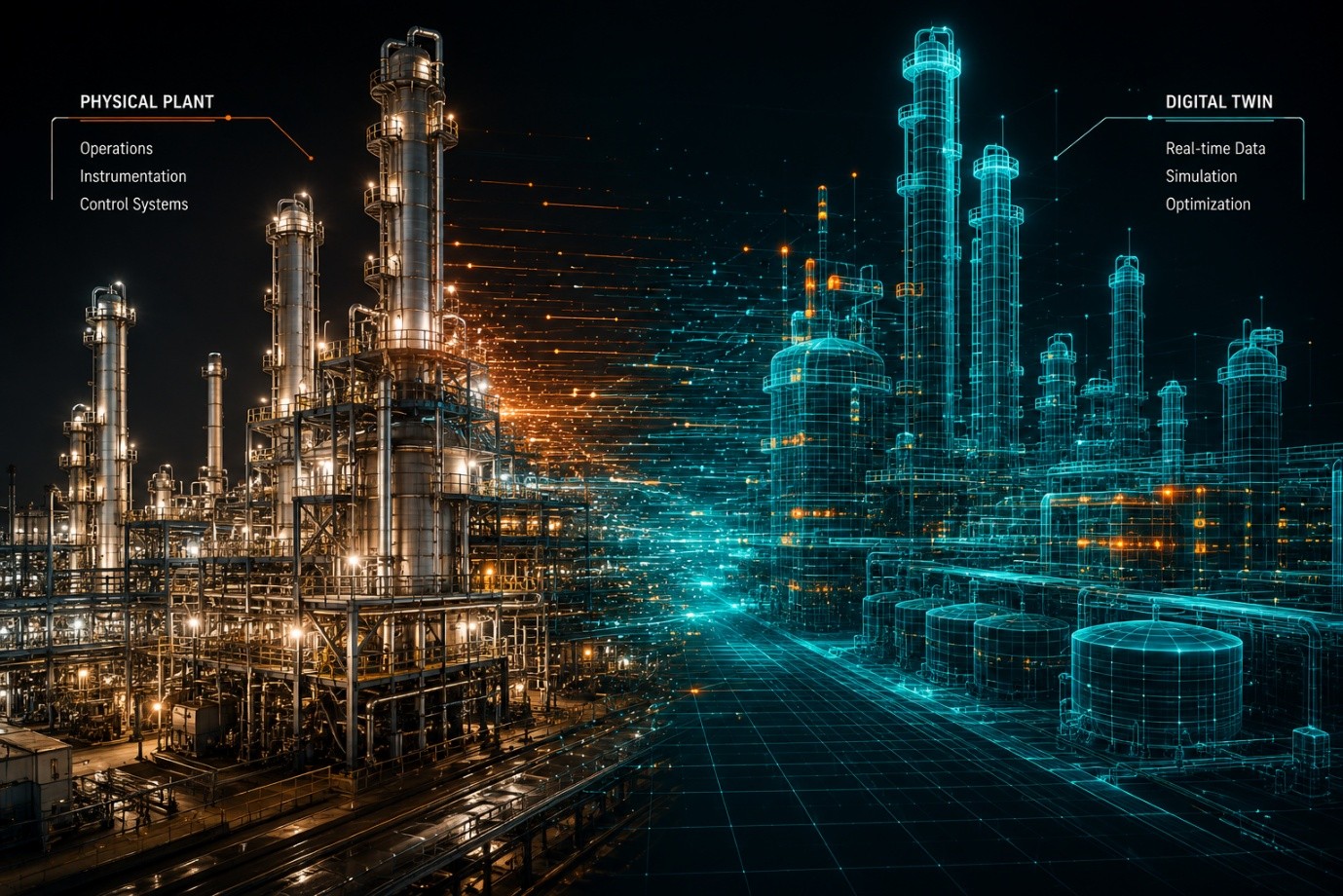
The term ‘digital twin’ has been abused by marketing departments until it can mean anything from a 3D drawing to a spreadsheet. Let us restore some precision, because underneath the hype sits one of the most genuinely useful ideas in modern industry.
A twin is a model with a pulse
A simulation is a model you run when you have a question. A digital twin is a model that runs continuously, synchronised with the live plant through streaming data. The distinction matters, because a twin that always reflects current reality can be asked questions at the moment they matter. What happens if we push feed rate 5%? How long until this heat exchanger fouls to the point of constraint? Would this batch recipe change break the temperature profile? The twin answers from the plant’s current state, not from a textbook baseline.
The live connection is not a feature of a digital twin. It is the whole of the definition. Without it you have a drawing.
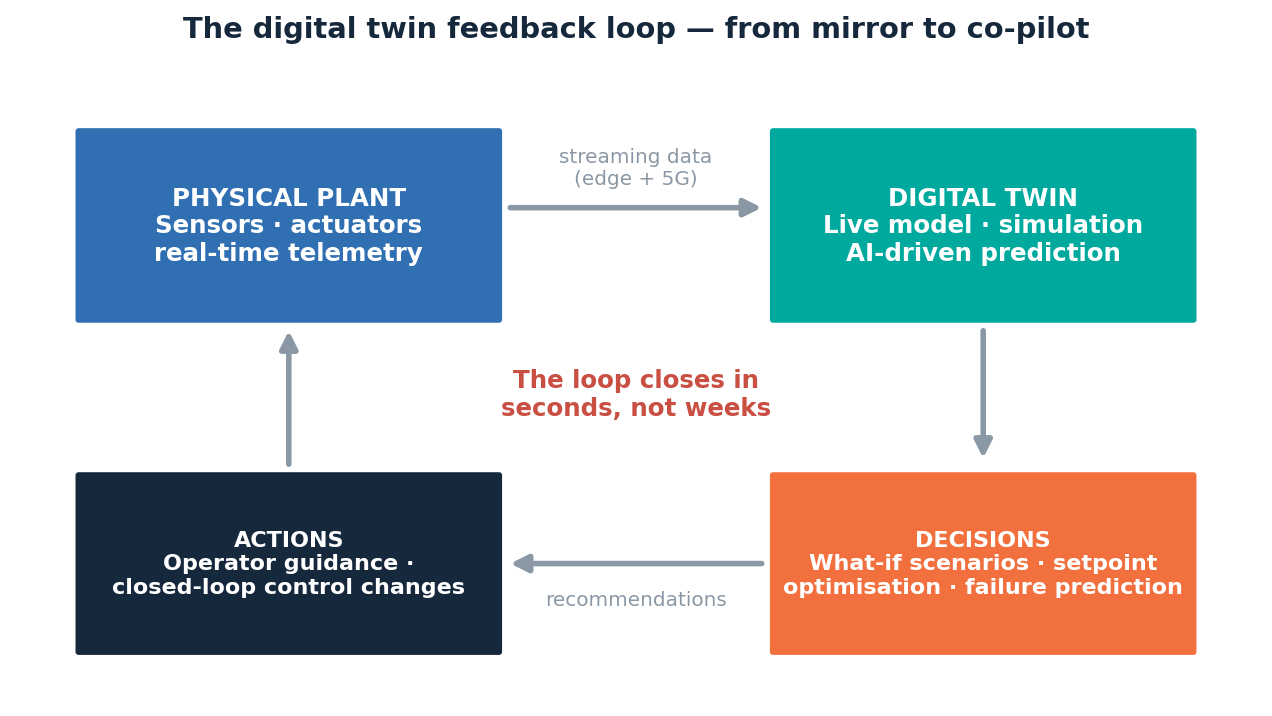
The stack has matured around that loop. Edge services stream sensor data with low latency, the twin updates its state continuously, simulation and machine learning models run against that state, and the results come back as operator guidance or, in the most advanced plants, as direct closed-loop adjustments. Networking advances — private 5G today, 6G on the horizon — keep shrinking the lag between plant and model.
The three maturity levels, and being honest about yours
Most disappointment with digital twins comes from a plant buying one tier and expecting another. The ladder is short and worth being blunt about.
Descriptive · the mirror
Reflects the plant state in a structured model. Already valuable on its own: it is the visual, contextualised front end to the data in your unified namespace.
Predictive · the forecast
Adds physics or machine learning models that project forward — remaining useful life, fouling trajectories, quality predictions.
Where most of the current return livesPrescriptive · the participant
Recommends or executes. Simulations predict failure probability, control systems adjust operating parameters, and the twin becomes an active participant in running the plant. This tier is arriving now, wrapped tightly with the agentic AI coming in Part 9.
Where twins earn their keep first
The unglamorous wins come first. Operator training simulators that let a new hire crash the virtual plant a dozen times before touching the real one. Commissioning twins that let you test control logic against a simulated process and cut weeks off startup. Maintenance twins that turn vibration and temperature streams into failure probabilities.
The glamorous wins — whole-plant optimisation, autonomous setpoint management — are real, but they rest on the boring foundations: good instrumentation, a clean data architecture, and trustworthy base-layer control. A twin of a badly measured plant is a beautifully rendered fiction.
Key takeaways
- A digital twin is a continuously synchronised model, not a one-off simulation. The live connection is the defining feature.
- Maturity climbs from descriptive (mirror) to predictive (forecast) to prescriptive (act). Most of the return today sits at the predictive tier.
- Training, commissioning and predictive maintenance are the proven entry points.
- Twin quality is capped by measurement and data quality. Foundations first.
What’s your take?
If your site has a twin, which tier is it honestly on — and did it start with training, commissioning or maintenance? Join the conversation.
A 12-part journey from the sensor to the self-driving plant.
Each week, one article — building from the 4–20 mA loop all the way to plants that run themselves. Brought to you by SynapseAI.
▦ See the full 12-part roadmap →
Wondering whether a twin would pay for itself on your plant?
We advise on industrial data architecture, industrial AI and digitalisation — vendor independent.