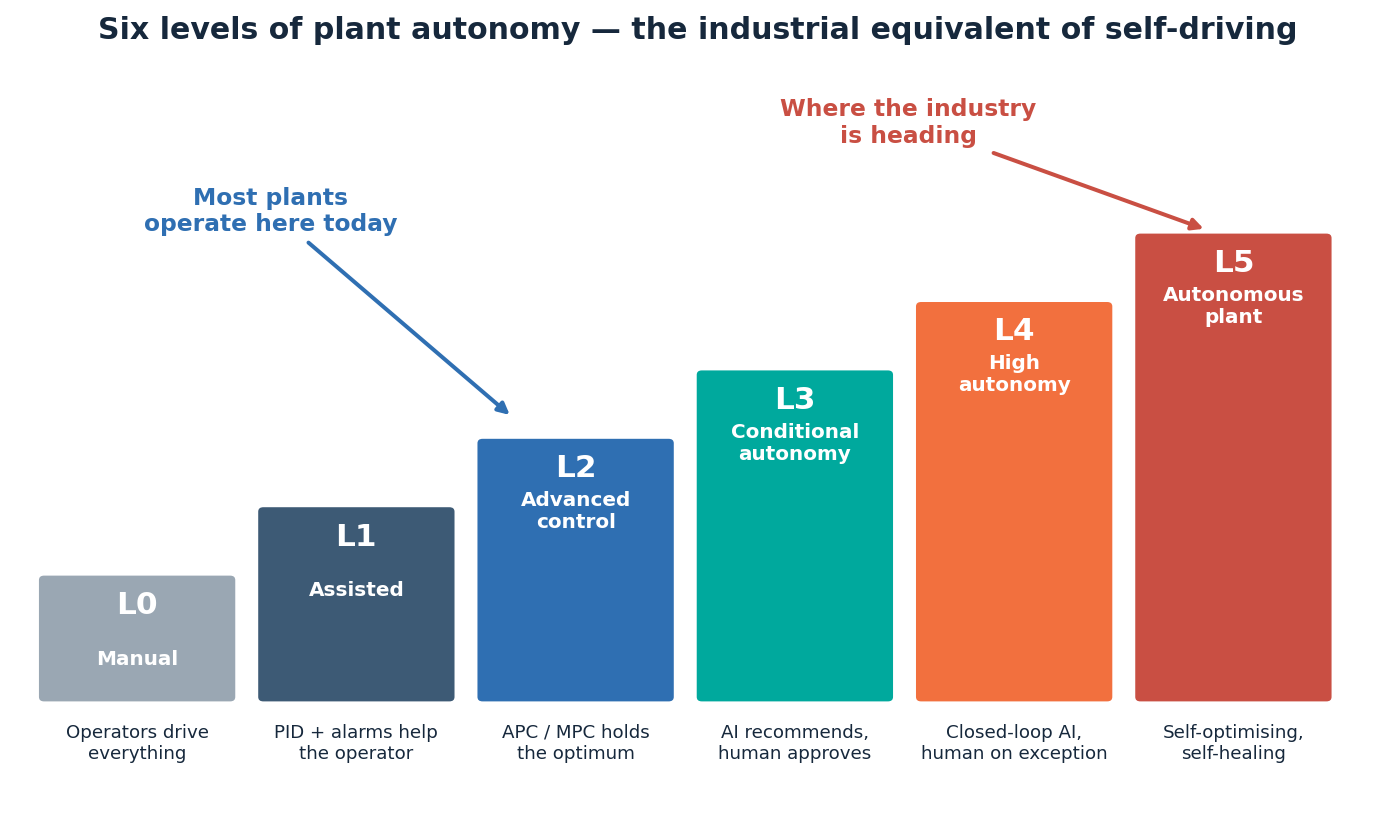
The self-driving car gave the world a vocabulary for autonomy: six levels, from ‘the human does everything’ to ‘there is no steering wheel’. Industry needs the same honest scale, because ‘autonomous plant’ currently means whatever the speaker wants it to mean. Here is the map, and an honest assessment of where we actually are.
The proven workhorse nobody outside industry knows
Advanced process control — chiefly model predictive control — has been quietly delivering L2 autonomy for forty years. An MPC controller holds a dynamic model of the process, predicts minutes to hours ahead, and continuously steers dozens of variables toward the economic optimum while respecting every constraint.
In refineries and petrochemicals it is standard equipment. If you have never heard of it, that is because it works: no drama, just margin.
The throughput gain usually quoted for a well-maintained APC application is 2–5%. It is the industry’s long-standing rule of thumb rather than a measured result, and it is repeated far more often than it is sourced. Treat it as the shape of the prize, not as a number for a business case.
Any conversation about AI-driven autonomy should start with respect for this installed base, and ideally some fluency in it. A good deal of what gets sold as revolutionary sits on top of it.
What AI adds above APC
Classic MPC has a known weakness: its models are built once and decay as the plant drifts. The newer layer closes that gap rather than replacing anything.
Machine learning keeps the models fresh from live data instead of letting them age out between projects.
Reinforcement learning finds strategies conventional design would never try, with real deployments in areas like combustion and energy management.
A digital twin simulates the consequence of a move before anyone makes it.
Agents watch market prices, energy tariffs and equipment health, then re-target the APC layer accordingly.
APC holds the optimum. PID still turns the valves. Neither goes away.
AI chooses the destination. Proven control layers do the driving. This is autonomy as an architecture of layers, not a single brain.
Lights-out: real, but narrower than the headlines
Fully dark factories exist — in semiconductor fabs, in warehouse logistics, and in discrete manufacturing cells running unattended night shifts. FANUC has run robots building robots for decades.
Scale that ambition to a refinery or a pulp mill, though, and physics pushes back. Continuous processes carry too much stored energy and too many failure modes for zero-human operation to clear today’s safety cases. The realistic near-term vision for process industries is not zero people. It is remote and centralised operations, with one hub running several sites, autonomous handling of routine states, and humans concentrated on abnormal situations, turnarounds and judgement. Fewer people per plant; more leverage per person.
What that means for a career
The implication is precise, and it is not the one people fear. The value of routine-state skills — watching, logging, nudging — is falling. The value of abnormal-situation skills — diagnosis, intervention, safety judgement — is rising, because those are exactly the situations autonomy hands back to a human, usually at the worst possible moment.
Build on the second category.
Key takeaways
- Use the six-level scale to cut through ‘autonomous plant’ marketing. Most of industry runs at L2–L3.
- MPC and APC are the forty-year-proven autonomy workhorse, standard in refining and petrochemicals.
- The modern stack layers AI — targets, adaptation, orchestration — above APC and PID. Architecture, not a single brain.
- Lights-out is real in discrete niches. For continuous process the trajectory is remote, centralised, exception-driven operation.
- Specialise in abnormal situations rather than routine ones. That is the part autonomy hands back.
What’s your take?
Which level is your plant honestly on — and is the thing stopping you from climbing technical, or organisational? Join the conversation.
A 12-part journey from the sensor to the self-driving plant.
Each week, one article — building from the 4–20 mA loop all the way to plants that run themselves. Brought to you by SynapseAI.
▦ See the full 12-part roadmap →
Working out which level is worth reaching for?
We advise on industrial data architecture, industrial AI and digitalisation — vendor independent.