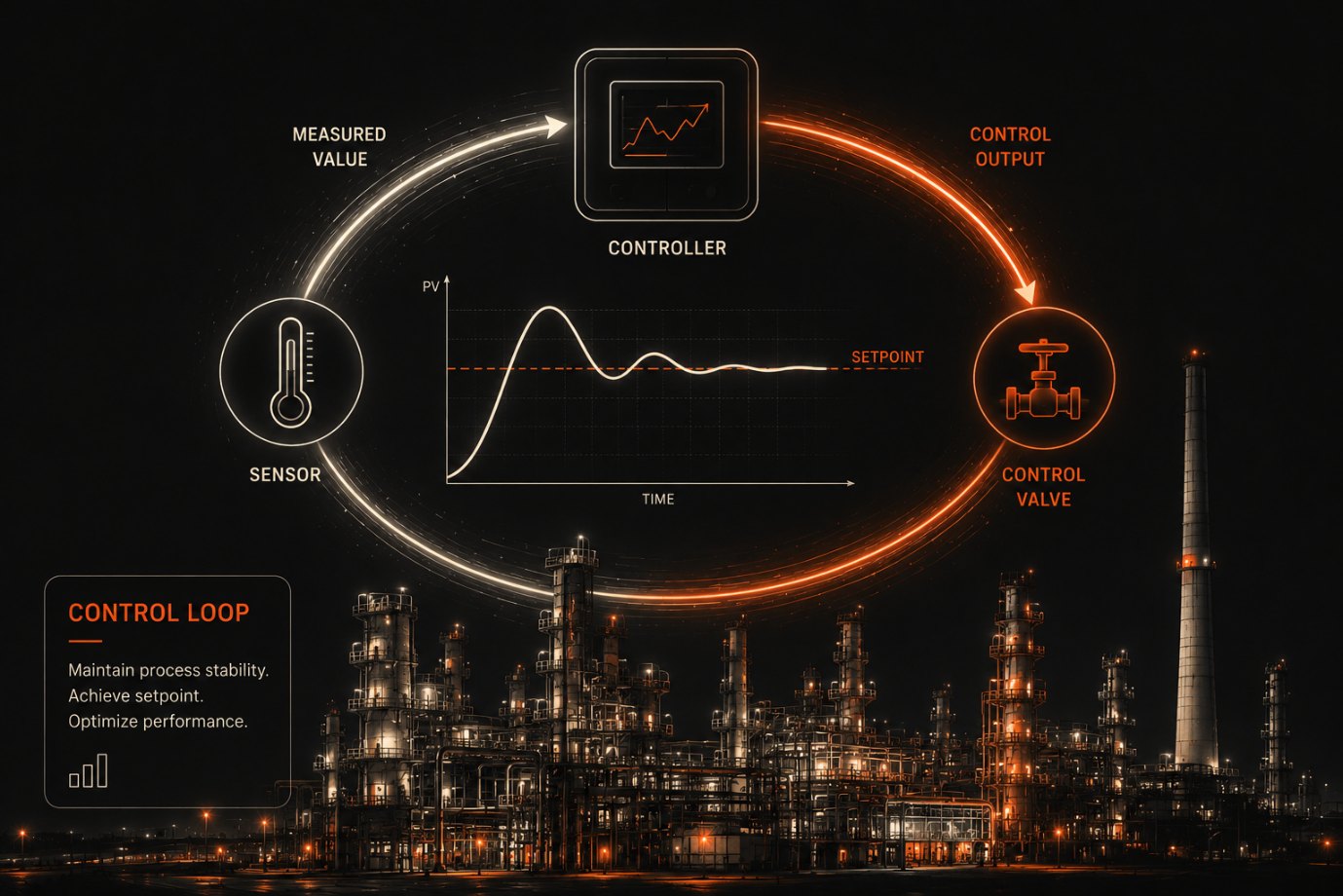
Strip away every buzzword, and the beating heart of industrial control is an algorithm you can write on a napkin. Proportional, Integral, Derivative. It predates the transistor. It runs your car's cruise control, your building's chiller, and roughly 95% of the regulatory control loops in every process plant on Earth. And here is the industry's open secret: a huge fraction of those loops perform poorly — surveys across industries consistently find that only around a third of loops deliver acceptable performance, with the rest oscillating, sluggish, or simply switched to manual because operators stopped trusting them.
Three personalities in one controller
Proportional action reacts to the error right now — the bigger the gap between setpoint and measurement, the harder it pushes. Alone, it's quick but complacent: it settles close to the target, never quite on it.
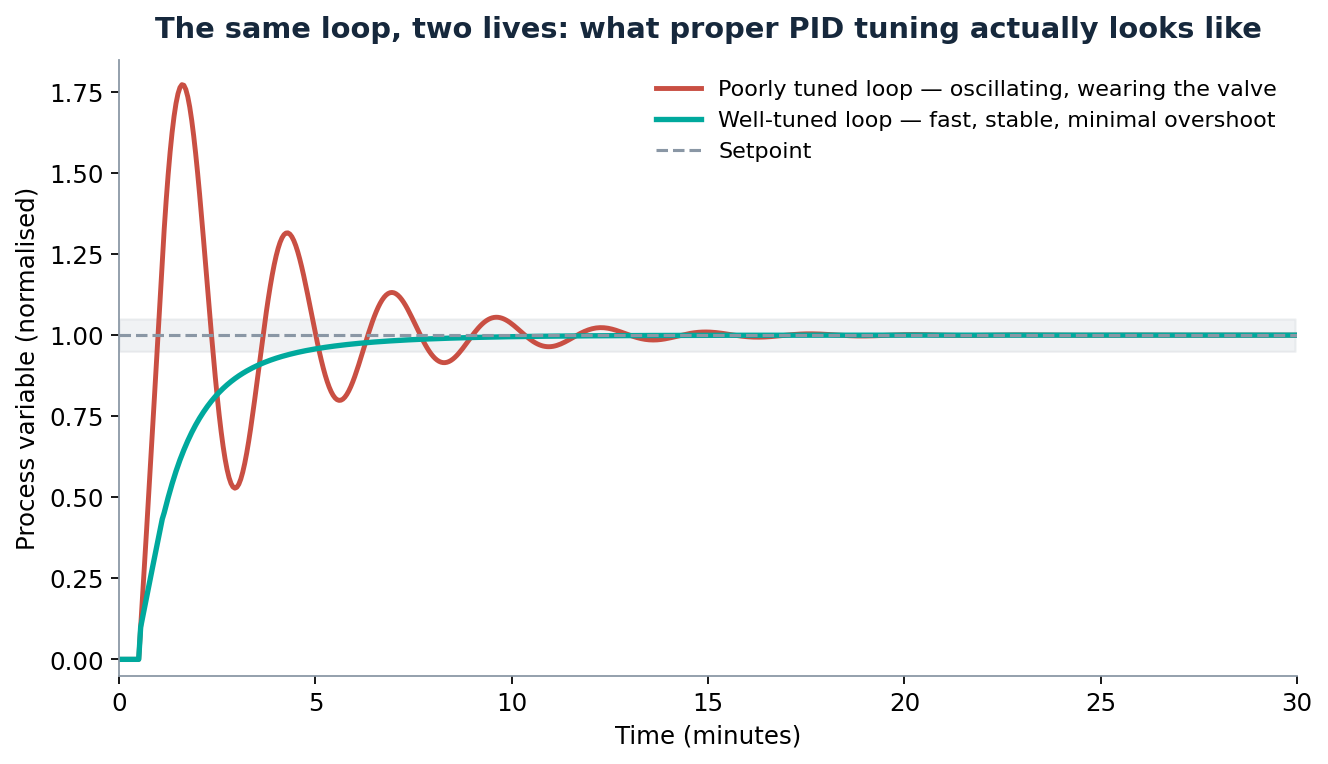
Integral action has a memory. It accumulates every second of past error and keeps pushing until the error is genuinely zero. It kills offset, but given too much authority it overshoots and oscillates — impatience disguised as diligence.
Derivative action watches the rate of change and brakes early, like a driver easing off before a bend. Used sparingly it calms a loop; overused, it amplifies every flicker of measurement noise into valve movement.
Tuning is the art of balancing these three temperaments against the personality of the process — its gain, its lag, its dead time. Get it right and the loop disappears into the background for years. Get it wrong and the plant pays for it every single minute.
The money hiding in your trend screens
An oscillating flow loop upstream becomes a disturbance to the temperature loop downstream, which passes it to the pressure loop after that. Variability propagates through a plant like a wave. And variability has a direct cash value: it forces you to run further from constraints. If your quality parameter swings ±2%, you must target 2% inside the spec limit to stay safe — giving away yield, energy or throughput continuously. Halve the variability and you can move the setpoint closer to the limit and bank the difference.
Variability is not a control-room aesthetic problem. It is the distance between where you run and where you could run.
The failure mode is rarely knowledge — it's attention. A mid-size plant has hundreds of loops and perhaps one engineer with 'controls' in their job title. Nobody notices the slowly degrading loop until it becomes the unit everyone complains about. That is why the practical question is not "how do I tune a loop" but "which ten loops should I spend this week on". Answering that well — identifying the oscillators, the valve-stiction cases and the loops quietly left in manual — is most of the job.
The tuning itself is a separate skill, and one worth doing properly rather than by feel. We wrote a step-by-step method for it in a practical guide for the whole team, and the SynapseAI PID Tuner does the identification and simulation part from a recorded step test, so the numbers can be defended before they reach the controller.
Why AI hasn't retired PID, and won't soon
Every few years someone declares PID dead, to be replaced by neural networks or reinforcement learning. It never happens, for a good reason: PID is transparent, provable, and certifiable. An operator can understand why the valve moved. A safety case can be built on its behaviour.
What AI is actually doing is wrapping around PID — monitoring loop health, recommending tuning, adjusting setpoints from above — rather than replacing the regulatory layer itself. The future control room keeps PID at the bottom and gets smarter above it. Master the fundamentals; they are the substrate everything else gets built on.
Key takeaways
- PID runs around 95% of regulatory control loops; broad industry surveys suggest only about a third perform well.
- P reacts to the present, I remembers the past, D anticipates the future — tuning balances the three against the process personality.
- Loop variability has direct cash value: less variability means operating closer to constraints, which means yield, energy and throughput.
- The scarce resource is attention, not knowledge. Knowing which ten loops to fix this week matters more than tuning technique.
- AI wraps around PID (monitoring, tuning, optimising setpoints) rather than replacing it. The fundamentals remain the substrate.
What’s your take?
What fraction of the loops in your plant would you honestly call well tuned — and when did anyone last check? Join the conversation.
A 12-part journey from the sensor to the self-driving plant.
Each week, one article — building from the 4–20 mA loop all the way to plants that run themselves. Brought to you by SynapseAI.
▦ See the full 12-part roadmap →
Loops you cannot defend?
The SynapseAI PID Tuner identifies the process from a recorded step test and simulates the result before it reaches the controller.