Three products. One is in service today; two are in development and described as such. Each addresses a problem we have watched cost plants money.
Step-test analysis, process identification and simulated PID tuning. Available now.
A structured, searchable, auditable replacement for the paper shift logbook. In development.
A plant knowledge system for finding the reasoning behind past decisions. In development.
Loops oscillate, sit in manual or drift — wearing valves, wasting energy and moving product quality around.
Select a node
A badly tuned loop rarely announces itself. It oscillates gently, sits in manual, or drifts — and because the plant still makes product, nobody fixes it. The Tuner turns a step test your team already has into tuning you can defend in a management-of-change review.
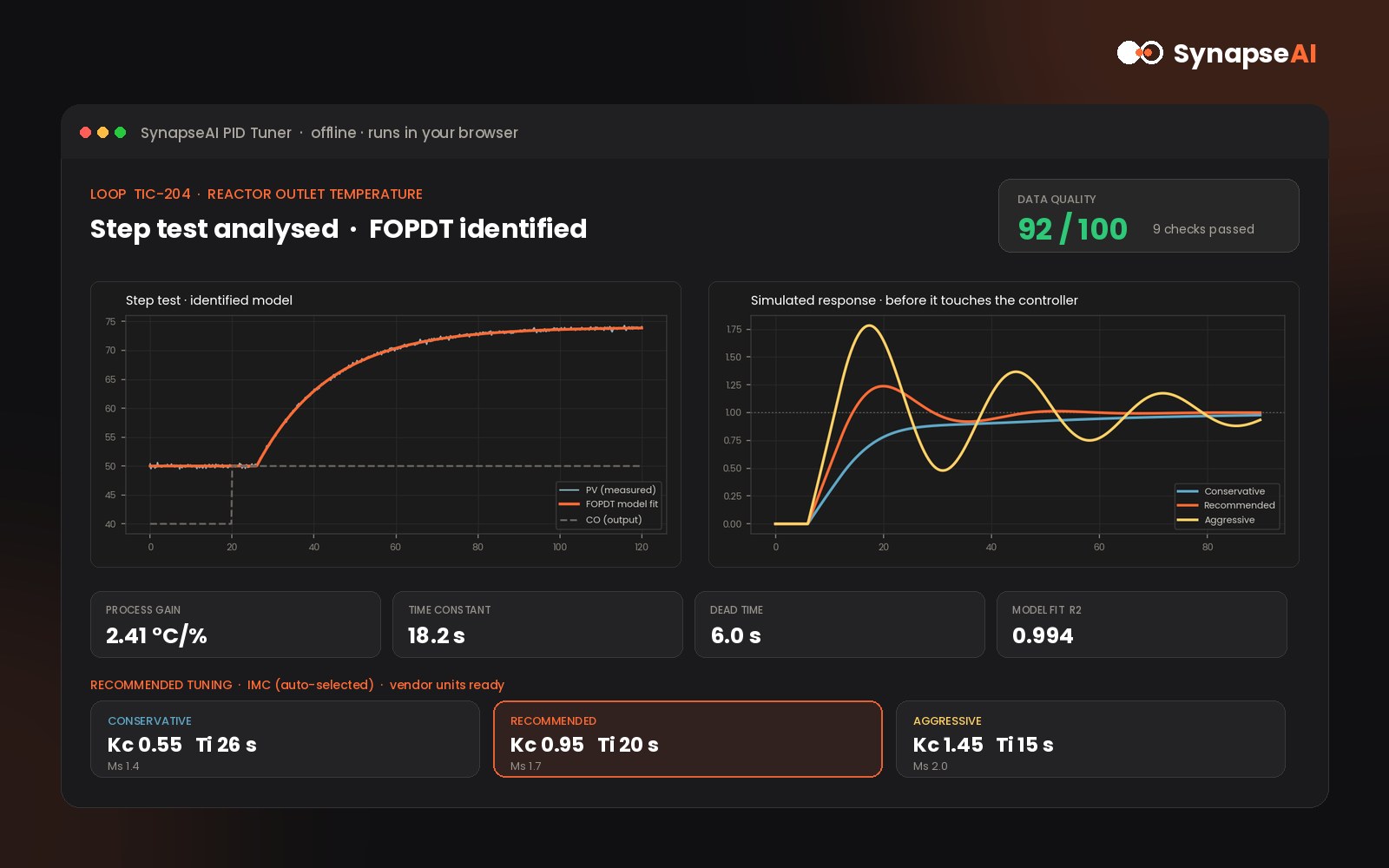
Nine checks run on the step test before any maths: sampling resolution, noise, baseline stability, settling window, step size and model fit. The result is a 0–100 confidence score. If the test cannot support dependable tuning, it says so and explains how to record a better one.
Automatic step detection, a two-point initial estimate, then non-linear least-squares refinement to a first-order-plus-dead-time model. Closed-loop identification is supported, so a test recorded with the controller in auto is usable — the loop does not have to go into manual.
Six methods — IMC, Lambda, SIMC, Ziegler-Nichols, Cohen-Coon and AMIGO — with the appropriate one selected for the loop and the reasoning shown. Each candidate runs against the identified model through a discrete ISA PID with derivative-on-PV, derivative filtering, output clamping and anti-windup.
Conservative, recommended and aggressive sets, each with overshoot, rise time, settling time, IAE and a maximum-sensitivity (Ms) figure. Values are formatted for the target controller, and a management-of-change report is produced in one step.
Most retunes fail for unglamorous reasons: bad data taken at face value, the wrong controller form, a gain entered in the wrong units, or a valve problem treated as a tuning problem.
Give a typical tuner a poor step test and it returns confident, wrong numbers. This one scores the test before it calculates anything.
Each set carries a maximum-sensitivity figure, so "conservative" and "aggressive" have a defensible engineering meaning rather than a marketing one.
It detects a PV in engineering units and normalises to percent of span, so the gain typed into the faceplate is the gain that was intended.
Flow, pressure and temperature, plus integrating level with a choice between tight control and averaging or surge damping.
Flow loops receive no derivative. Trip-adjacent loops suppress the aggressive set. Ziegler-Nichols and Cohen-Coon are detuned from their raw quarter-amplitude forms.
It flags the mechanical signature of a sticking valve, because no set of gains has ever fixed one — and saying so is what earns an engineer's trust.
Tuning constants are meaningless without the controller form and units they belong to. Values come out in the fields and units of the target system — which is where most retunes quietly go wrong, in the last metre between the calculation and the faceplate.
The engine runs in the browser from a single file. Step-test data stays on the machine — it is never uploaded, so there is nothing for IT or OT security to approve and no plant data leaving site. The software reads a recorded test; it never touches a running loop.
Tuning more loops in less time, with the working shown.
Separating a tuning problem from a valve or instrument problem before the callout.
Fewer loops running in manual, and less variability on quality-critical measurements.
Defensible loop tuning at commissioning, with the documentation attached.
Paper logs get lost, handwriting gets misread, and the context behind a decision disappears between crews. When an incident is investigated months later, the record that would explain it is a box of notebooks.
Current availability: in development. We are working with sites that want to shape it.
Crew, state, open items.
In the operator’s words.
Tagged to the asset.
Raised once, visible after.
Owner and expectation.
Structured, not prose at 06:00.
Evidence that stands up.
A plant's real knowledge is not in one system. It is distributed across procedures, engineering documents, maintenance records, incident reports, shift notes and troubleshooting history — and the experience of people who may no longer be on site.
The asset the question is about. Everything below attaches to this tag, not to a folder somebody has to find.
Procedures, P&IDs and engineering documents. Maintenance and reliability records. Incident and near-miss reports. Shift logs. Vendor manuals. The reasoning of the engineer who solved it last time.
Not a list of search results. The reasoning and the evidence behind a previous decision — what was tried, what was ruled out, and why.
A system that brings those sources together and lets an engineer or operator ask a question in plain language, then shows the source documents behind the answer.
No downtime figures, no percentage improvements, no case studies. It is in development, it has not been proven at scale, and we will publish numbers when there is evidence for them.
Why was K‑204 taken off line in March, and what was ruled out first?
Vibration on the outboard bearing climbed over three consecutive nights. Lube-oil supply was checked first and ruled out. The same vibration signature had already cost this machine a coupling, so the bearing was changed at the next window rather than run to the shutdown.
Tell us what your control room struggles with. If the PID Tuner is not the right answer, we will say so.
PID tuning software that runs in a web browser. You give it a step test your team has already recorded. It scores the quality of that data, identifies a first-order-plus-dead-time model of the process, and returns three tuning sets — conservative, recommended and aggressive — each simulated against the identified model before you touch the plant.
Tuning values are output ready to type into the faceplate for Siemens PCS 7 and S7, ABB 800xA, Honeywell Experion, Yokogawa CENTUM and Emerson DeltaV. It also supports any controller using the ISA (standard), series or parallel PID form, with the correct units and field names for each.
No. The engine runs locally in the browser from a single file. Step test data is never uploaded to a server, so there is nothing for IT or OT security to approve and no plant data leaving the site.
A step test: a recorded change in controller output and the resulting process variable response, with timestamps. The Tuner runs nine data quality checks on that file first — sampling resolution, noise, baseline stability, settling window, step size and model fit — and gives a 0 to 100 confidence score before it produces any tuning.
Yes. Alongside flow, pressure and temperature, it handles integrating level control with a choice between tight control and averaging or surge damping. It also supports closed-loop identification, so you can work from a test taken with the controller in auto rather than dropping the loop into manual.
Not in the current version. Today it works from an exported file. A connected version that reads directly from a DCS, PLC or historian over OPC UA is in development, which will add on-demand loop analysis and fleet-wide loop health monitoring.
No. Plant Memory is in development. A small number of sites are working with us to shape it. We do not publish performance figures for it because there is not yet evidence to support them.