
Here is the dirty secret of plant IT. In a traditional architecture, getting one new data flow from a PLC into a business dashboard means a custom point-to-point integration — through the SCADA, through the historian, through a middleware layer, each hop owned by a different team and a different budget. Multiply that by every system that wants data and you get integration spaghetti that consumes entire careers. The unified namespace (UNS) is the industry’s answer, and it is refreshingly simple.
One place where everything talks
A UNS is a central, real-time data hub — almost always an MQTT broker — organised in a consistent hierarchy, typically site / area / line / cell, borrowing its shape from ISA-95. Every system publishes its data into the namespace once, and every system that needs data subscribes to it there. The PLC does not know or care that a machine learning model, a dashboard and the ERP are all consuming its data. Add a new consumer tomorrow and nothing at the edge changes.
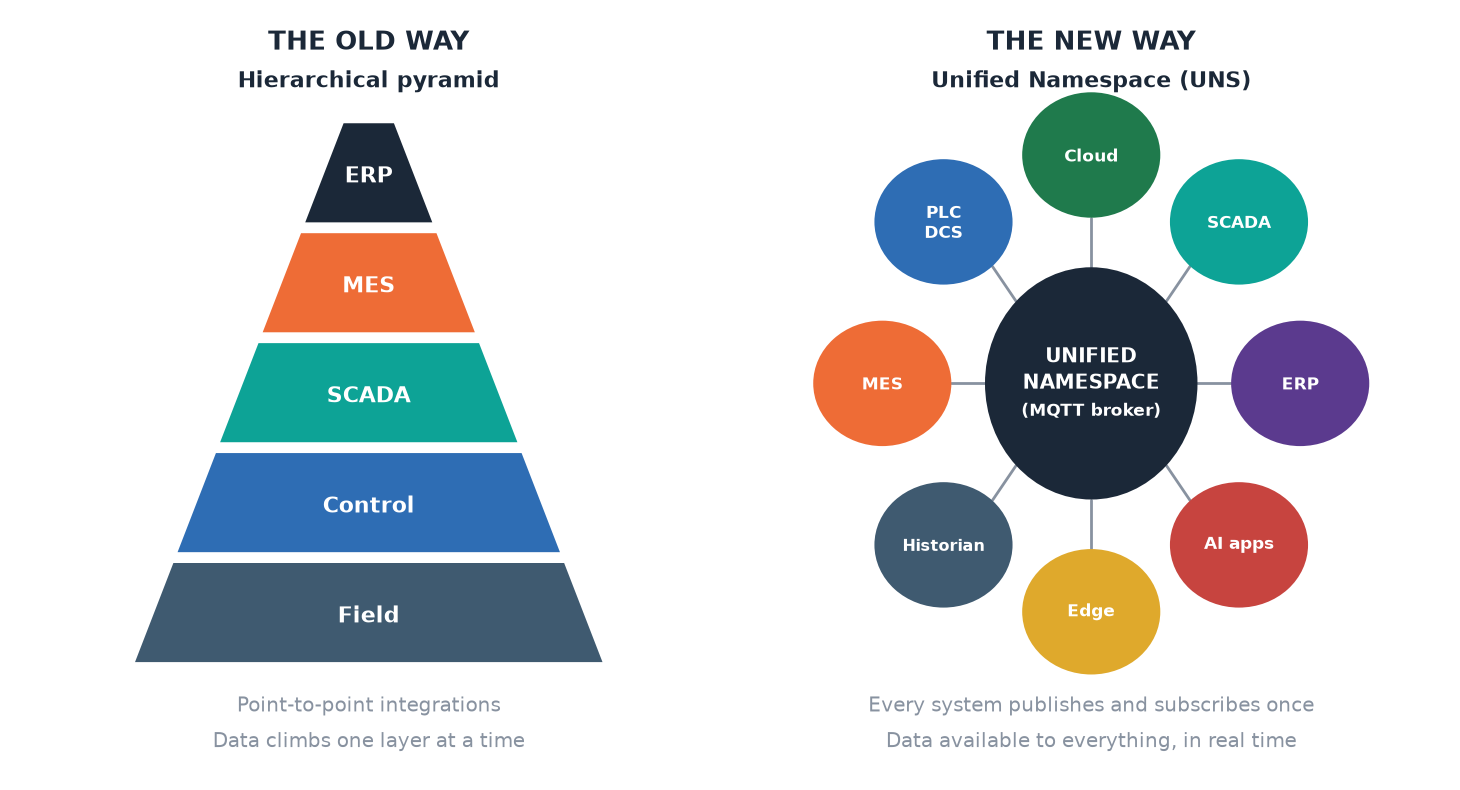
The phrase you will hear is that the UNS is the single source of truth for the current state of the business. That is the ambition: look at the namespace and you see the plant, live, in one structured tree. It is what makes the software-defined factory practical — the data architecture acting as the factory’s nervous system rather than as another integration project.
└─ Cork/ ← site
└─ Packaging/ ← area
└─ Line3/ ← line
└─ Filler01/ ← cell
├─ State → Running
├─ Rate → 412 units/min
└─ FillTemp → 62.4 °C
What it takes to do it well
The technology is the easy part — a broker, some edge gateways, Sparkplug B for payload discipline. The hard part is governance. A namespace is only unified if people agree what things are called. Is it Line3, or L03, or PackagingLine_3? Who owns the schema? What happens when somebody renames a tag on a Tuesday afternoon?
Successful UNS projects treat naming as seriously as piping standards. Failed ones try to boil the ocean with a big-bang enterprise rollout.
The projects that work start with one line or one use case and grow outwards, because a naming convention only survives contact with the plant if the people using it helped write it. The projects that stall usually got the broker running in a fortnight and then spent a year arguing about vocabulary in a steering committee.
Note what the UNS does not replace: your control systems, your safety systems, your historian’s long-term archive. Fast control stays at the controller, where it belongs and where it is safe. The UNS is the real-time distribution layer above it. The pyramid does not so much vanish as get hollowed out, with its layers becoming publishers and subscribers instead of gatekeepers.
Why AI teams love it
Ask any industrial data scientist where their time goes and they will all say the same thing: not modelling — data access. Months of it. Finding the tag, working out what it means, discovering it was renamed in 2023, negotiating with whoever owns the historian. A UNS collapses that. Contextualised, consistently named, real-time data available by subscription is exactly the substrate machine learning needs, and it is available to a new project on day one rather than in quarter three.
That is the argument to make internally, and it is a scheduling argument rather than a technology one. Plants with a working namespace deploy AI use cases in the time it takes integration-spaghetti plants to get the data extract approved. If your site has AI ambitions for 2027, the UNS conversation needs to happen in 2026.
Key takeaways
- A UNS is a central real-time hub, usually MQTT, where every system publishes once and subscribes as needed — integrations stop multiplying.
- The technology is simple; the governance — naming, ownership, schema discipline — is where projects live or die.
- The UNS complements rather than replaces control systems and historians. It is the distribution layer, not the control layer.
- For AI initiatives, a UNS is the single biggest accelerator: contextualised real-time data on tap.
What’s your take?
Has your site started a namespace — and did it stall on the broker or on the naming convention? Join the conversation.
A 12-part journey from the sensor to the self-driving plant.
Each week, one article — building from the 4–20 mA loop all the way to plants that run themselves. Brought to you by SynapseAI.
Thinking about a namespace and unsure where to start?
We advise on industrial data architecture, OT security and digitalisation — vendor independent.