Independent consulting on industrial automation, industrial AI, digitalisation and OT cybersecurity. Vendor-neutral, because there is no hardware margin to protect.
A site installs analytics on a unit whose control loops are in manual. A vendor is selected before the requirement is written. A pilot runs for a year with no baseline to compare against. None of this is incompetence — it is what happens when the technology conversation starts before the operational one.
Our work starts at the other end: the loop that hunts, the record that cannot be found, the decision that cannot be justified. Sometimes the answer is software. Often it is an instrument, a valve, or a procedure.
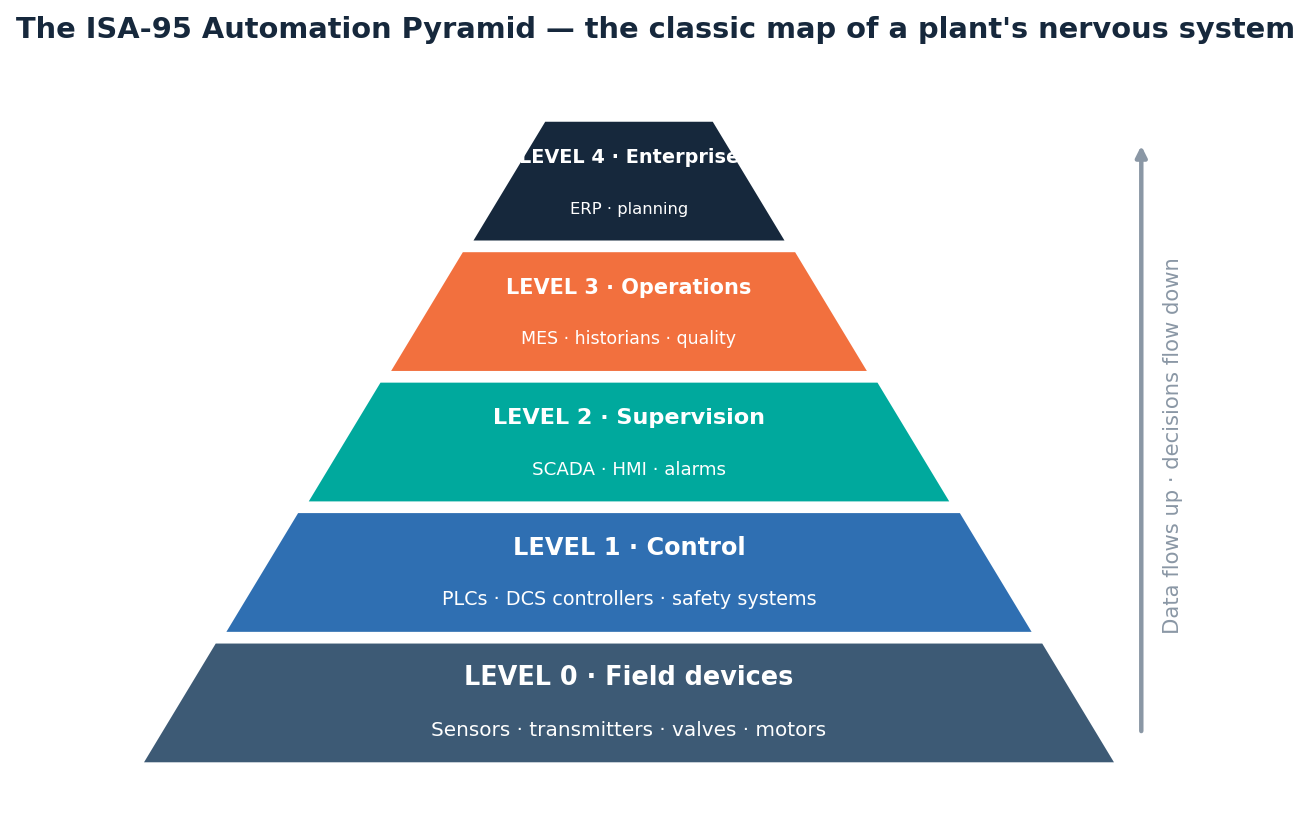
Automation architecture, control system modernisation and migration planning, instrumentation reviews, and reliability improvement on existing assets.
Where machine learning earns its place against the data a site actually holds — and where a control fix, an instrument or a procedure would do more for less.
Plant data, operations records and reporting: what to digitise first, what it connects to, and what it must produce to be worth the disruption.
OT security assessments, IEC 62443 guidance, network architecture and segmentation reviews, risk assessment, and a roadmap ordered by risk rather than by product.
KPI design that engineers and finance both accept, performance reporting, operational analytics, and energy and maintenance analysis.
CAPEX versus OPEX analysis, payback and risk assessment, technical due diligence, and business cases written so that an engineering argument survives a finance review.
This is not a methodology we sell. It is the order the work tends to happen in, and every stage is a point where the honest answer may be "no further".
Stated in the plant's own terms — this loop, this unit, this record, this decision — not as a technology category.
What the DCS, historian, CMMS and document store already hold, at what resolution and quality. This determines what is possible and usually shortens the list.
What a result is worth, how it will be measured, and against which baseline. Agreed before anything is specified.
The appropriate technology and supplier for the problem — sometimes ours, often not, occasionally none. Written plainly enough to be argued with.
On a real loop, unit or shift, scoped so that a wrong answer is cheap and a right one is visible.
Compare to the baseline agreed at step three. Keep what worked, stop what did not, and decide the next move on evidence.
Most industrial digital projects cannot prove what they achieved, because nobody recorded the starting condition. By the time the question is asked, the plant has changed, the feedstock has changed, and the argument is unwinnable.
Fixing that costs very little and has to happen first.
Throughput, variability and the cost of running below design.
Control system life cycle, modernisation and where to spend a limited capital budget.
Segmentation, remote access and security work that operations will actually accept.
Whether an industrial AI or digital programme is grounded in the data that exists.
Specification, commissioning support and defensible automation scope at handover.
Technical due diligence on industrial technology and the operations behind the numbers.
Including when that is nothing we sell.
Deciding where machine learning or AI methods create operational value in a plant, and where they do not. In practice: reviewing operations and the data that actually exists, identifying candidate use cases, testing their feasibility against that data, and agreeing one first step that can be measured. It frequently concludes that a control or instrumentation fix is the better investment.
Independent. SynapseAI does not take reseller margin on third-party automation hardware, so technology selection advice is not shaped by what would be most profitable to sell you.
Yes. OT cybersecurity assessments, IEC 62443 guidance, network architecture and segmentation reviews, risk assessments and prioritised security roadmaps for operational technology environments.
By agreeing the measurement before the work starts. KPI frameworks covering maintenance, production, energy, reliability, asset health, safety and adoption are defined first, so a baseline exists before any change is made and the result is defensible afterwards.
Both. Plant owners and operators engage SynapseAI for consulting and software. Separately, automation and industrial software companies engage SynapseAI for commercial work in EMEA and Asian markets — see commercialisation.